Meet Kobi: one AI, two modes
Kobi is KubeBolt's AI SRE. Kobi Copilot answers when you ask and ships in every edition; Kobi Autopilot acts on its own under your rules on KubeBolt Cloud.
Kobi is KubeBolt’s AI SRE — the same character everywhere in the product, working in two modes:
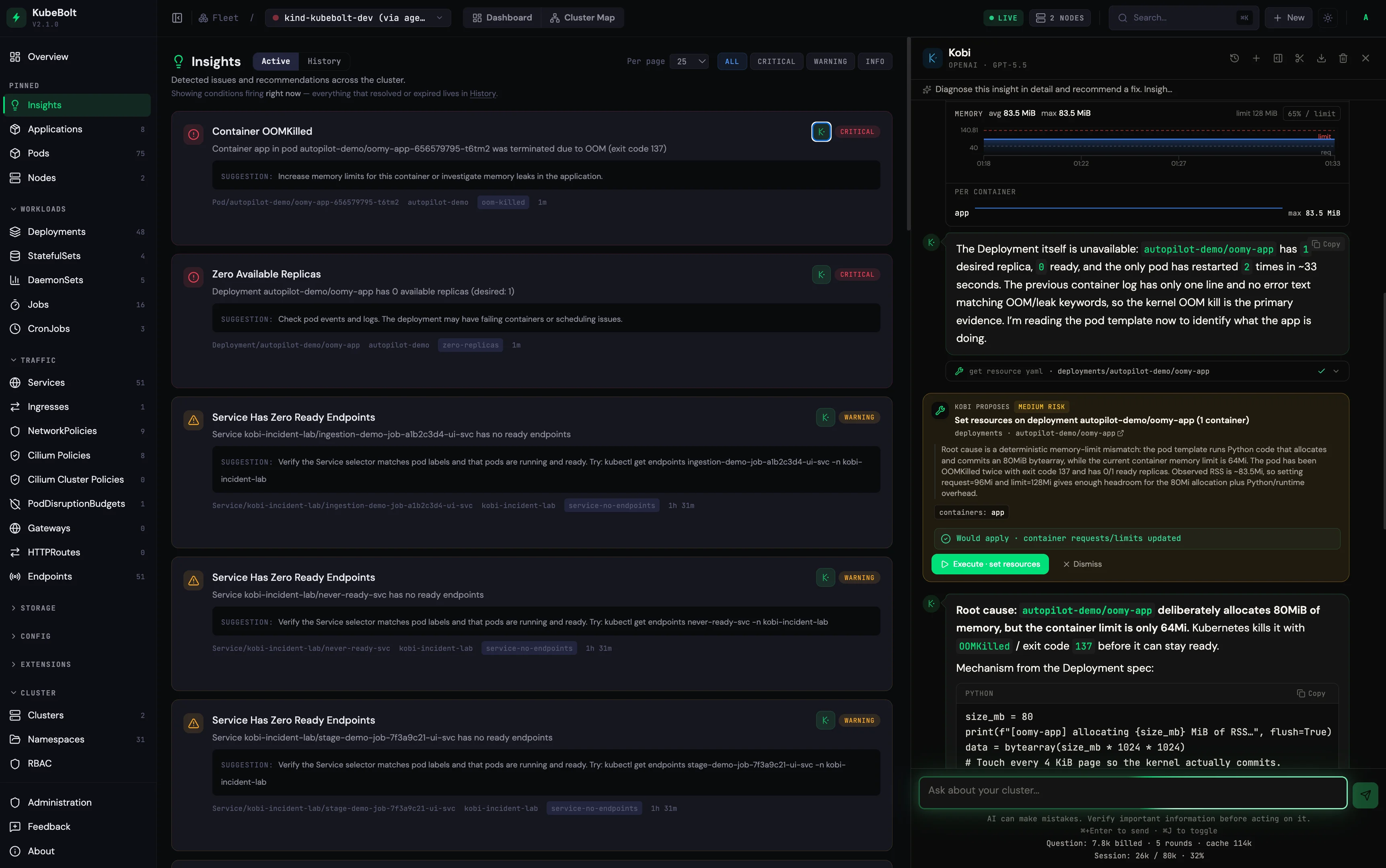
- Kobi Copilot: you ask, Kobi answers. Press
⌘J, describe the problem, review the proposal, click Execute. It ships in every edition: in the open-source core you bring your own LLM key; on KubeBolt Cloud the AI is managed. - Kobi Autopilot: Kobi acts on its own — you approve the destructive part. It wakes on incidents, investigates, remediates and writes the postmortem. Autopilot runs only on KubeBolt Cloud, in open beta.
Copilot never changes anything by itself: every fix is a proposal that runs only when you click Execute, under your role, and lands in the audit trail. The difference between the modes is who drives.
When does a human sign off in Autopilot?
That depends on Autopilot’s operating mode — configurable per organization on KubeBolt Cloud:
| Operating mode | What executes | Human sign-off |
|---|---|---|
| Suggest only | Nothing — Kobi investigates and proposes; you apply the commands yourself | Not applicable (never executes) |
| Approve & Execute | Every action, after your approval | Every action waits for it |
| Autonomous | Low-risk actions, automatically | Destructive / high-risk actions always wait for it |
A resolved incident is “auto-resolved” either way — the incident view marks whether an action paused for a human sign-off, as an attribute, not a different status.
The rest of the guardrails
Beyond the operating mode, Autopilot’s autonomy is bounded by:
- Per-organization opt-in — off by default; enabling it is an explicit decision.
- Unattended schedule window — restrict autonomous action to days, hours and a timezone; outside the window incidents are recorded, not acted on.
- Platform autonomy ceiling — a platform-level cap no organization can exceed.
- Full audit — every investigation, decision and action lands in the incident timeline and the action audit trail.
Where to go next
- Kobi Copilot — the assisted mode: tools, providers, MCP.
- Enabling Kobi — turning Kobi Copilot on with your own key when you self-host.
- KubeBolt Cloud — where Kobi Autopilot runs today, in open beta from the Free plan.
- Actions & Governance — the audit trail and the governance switches behind every action.