Cluster Map
Interactive topology of resource relationships in Grid, Flow and Traffic layouts.
Layout modes
- Grid — Compact grid of resources within namespace regions. Best for overview.
- Flow (the default) — Horizontal dependency chain: Ingress/Gateway → HTTPRoute → Service → Deployment → ReplicaSet → Pod. Best for understanding how requests reach a workload.
- Traffic — Only what is actually talking: pods that appear in observed Hubble flows, the Services in front of them, and external destinations (by FQDN or IP) as their own nodes. It needs the agent with Hubble enabled; without flow data the canvas stays empty and explains why.
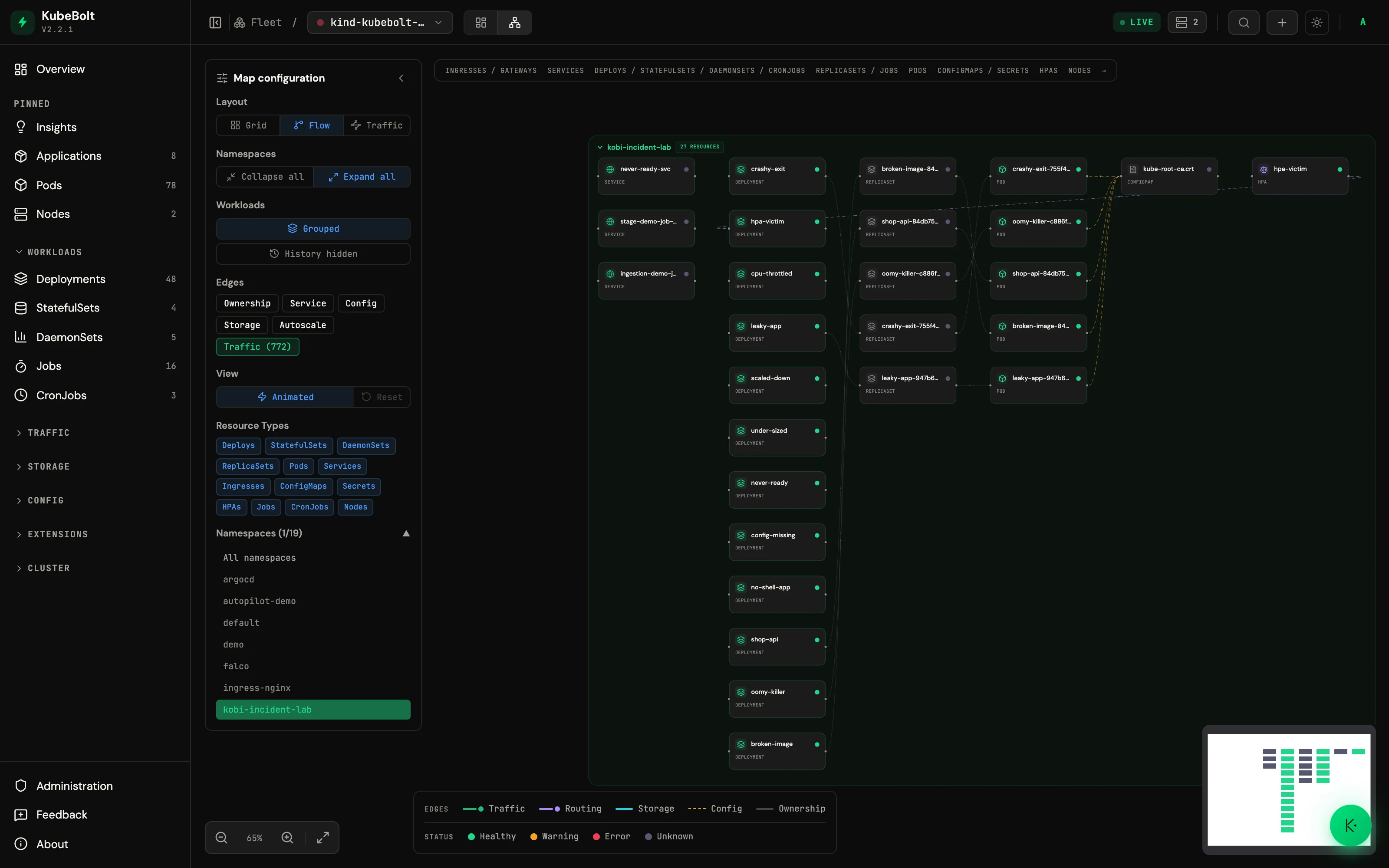
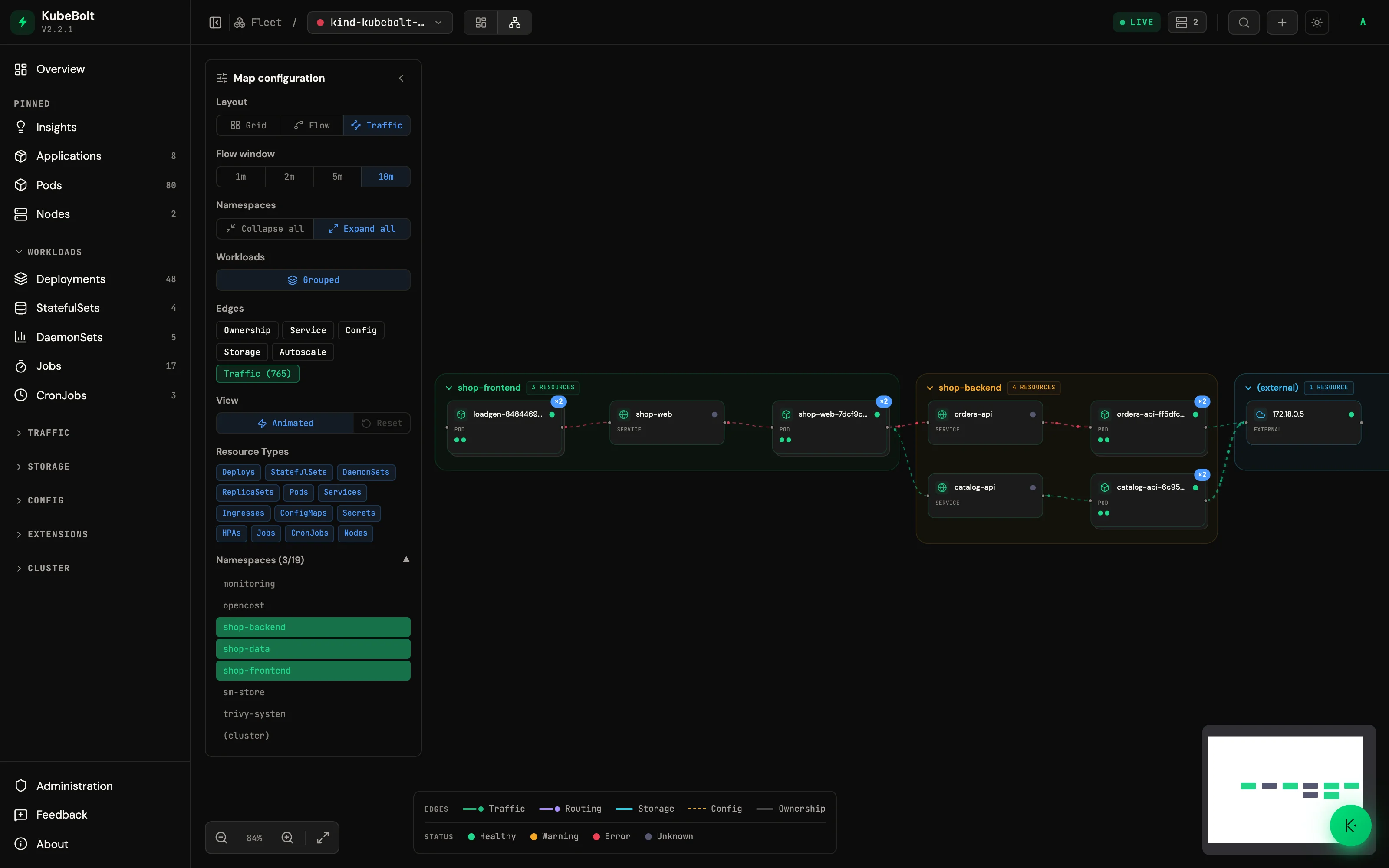
Namespace regions are ReactFlow group nodes with child resource nodes, laid out in a grid whose column count grows with the number of visible regions (up to 4), with infrastructure namespaces and external endpoints placed last. You can filter by resource kind and namespace, toggle edge groups (Ownership, Service, Config, Storage, Autoscale, Traffic), and drag nodes; the layout choice is remembered per browser.
Relationship Detection
| Relationship | Detection Method | Edge Type |
|---|---|---|
| Deployment → ReplicaSet → Pod | ownerReferences chain | owns |
| Service → Pods | Label selector matching | selects |
| Ingress → Service | spec.rules.http.paths.backend | routes |
| Gateway → HTTPRoute | HTTPRoute spec.parentRefs | routes |
| HTTPRoute → Service | spec.rules.backendRefs | routes |
| HPA → Deployment | spec.scaleTargetRef | hpa |
| Pod → PVC | spec.volumes.persistentVolumeClaim | uses |
| PVC → PV | spec.volumeName | bound |
| Pod → ConfigMap/Secret | volumes + envFrom | mounts / envFrom |
| Pod → Secret | spec.imagePullSecrets | imagePull |
| Pod → Pod / external endpoint | observed Hubble flows | traffic |